
Build a strong family culture with shared values, routines, and traditions.
In 2024, 37% of employees leaving their jobs said they did it for one primary reason. It wasn’t pay. It wasn’t better benefits. And, it wasn’t even a better opportunity somewhere else. It was poor engagement and workplace culture.
Whoa.
Read that again.
More than a third of people quit because of bad culture. And when you add well-being and work-life balance into the mix, those factors accounted for a whopping 68% of employees leaving their jobs.
That’s the power an environment has over the way people behave, communicate, contribute, and connect with one another. And if positive culture matters that much in the workplace, just imagine how essential it is at home.
When I created Lauren Magers’ Happy Life System™, one of my biggest inspirations was a simple realization: successful businesses, teams, and organizations don’t thrive by accident. They operate with systems. They establish shared values, set clear expectations, define roles, and create a culture that keeps everyone moving in the same direction.
Yet somehow, we weren’t applying those same proven principles at home.
So, I did.
Because just like a business can’t truly thrive without a positive environment and shared values, neither can your home. You need an intentional family culture that represents who you are, what you stand for, and how you live those values every day.

What is Family Culture?
A family culture is a shared identity that every member of the family has adopted. It’s the values, beliefs, expectations, traditions, habits and behaviors that define your way of living together.
Every family has culture. It’s what everyone sees when they walk into your home. What do you obviously value? What habits and routines do you share? How do you communicate? What traditions and daily rituals shape the rhythm of your days?
But not every family culture is a positive one.
Maybe your house is constantly chaotic. Everyone is rushing in different directions. You have to ask your kids five times to do something before it gets done. You handle nearly every responsibility because it’s easier than fighting about it. Everyone retreats to separate screens at the end of the day. When something goes wrong, yelling, blaming, or shutting down is the norm.
That’s a culture of disorder, disconnection, and dependence. It’s a culture that values convenience over contribution, reaction over intention, and individuality over family unity.
If this isn’t your family identity, don’t worry. You can cultivate a positive family culture no matter what patterns and programs you’re stuck in today! You can stop living at a lower frequency and raise the vibrations of your family to live in your full potential. I believe you just need the right guidance, which I’ll provide below!
Why Is Family Culture Important?
Because the culture your kids grow up in shapes the way they learn to exist in the world.
Home is where they first learn how to communicate, contribute, solve problems, handle conflict, take responsibility, treat other people, and understand what it means to be part of something bigger than themselves. If we want to raise confident, capable, world-ready humans, we have to intentionally create a family culture that gives them opportunities to practice those skills RIGHT NOW.
And research backs this up! The values children develop are heavily influenced by what they experience at home. When families model and reinforce compassion, cooperation, generosity, and helping others, those values often become part of who their kids are. Research has also linked consistent family routines (like chores, meals, play, bedtime, etc.) with better social and emotional adjustment in young children.
So, you’re not just building a happy home. You’re raising kids who can:
- Stand up for what’s right, even when it’s unpopular.
- Take responsibility for their choices instead of blaming someone else.
- Handle disagreements without losing respect for the person on the other side.
- Receive feedback without crumbling, getting defensive, or giving up.
- Solve problems instead of waiting for someone else to rescue them.
- Adapt when life doesn’t go according to plan.
- Advocate for themselves while still considering the needs of others.
- Build deep, healthy relationships and know how to maintain them.
- Maintain strong family bonds that don’t disappear once they grow up and leave home.
- Take risks and pursue big dreams, even when success isn’t guaranteed.
- Know what they believe and who they are, even when the world challenges it.
That’s what it means to raise world-ready humans.
How to Create a Strong Family Culture in Your Home
Whether you want to completely change your family dynamics or 10x the positive culture you’ve already created, I can help you. As a CEO, entrepreneur, mom of four, and family leadership pioneer behind the revolutionary Happy Life System™, I’ve spent more than 15 years testing and refining what actually works. My approach combines proven business and leadership principles with neuroscience, behavioral psychology, and real-life experience raising my own family.
Today, these systems have helped thousands of parents reach the gold standard for how families live, lead, and function together.
So, where do you start? Here’s how to build a strong family culture using the principles of Lauren Magers’ Happy Life System™:
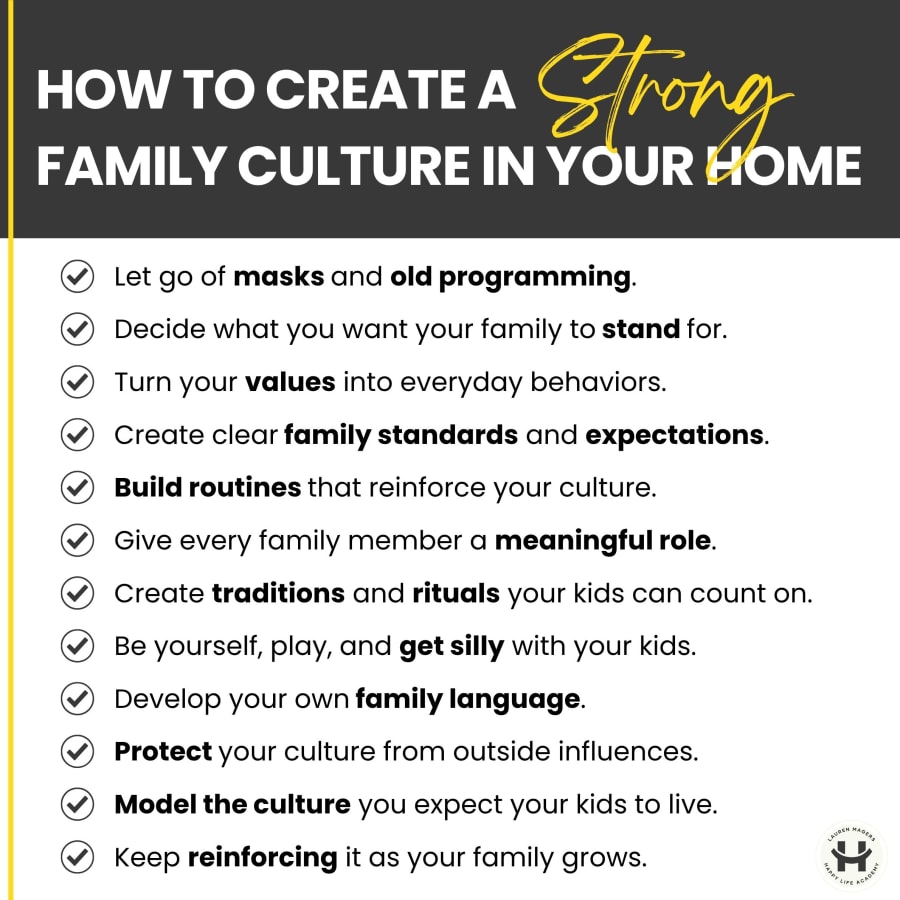
Step 1: Let go of masks and old programming.
So much dysfunction in our lives comes from generational patterns and old masks we’ve carried for years. Maybe your family always called you “the responsible one,” or you once held the title of team captain. Those identities can program you to think, behave, and respond in certain ways.
Maybe it made you hardworking, driven, or dependable. But those same patterns might make you afraid to ask for help, desperate to keep everyone happy, uncomfortable setting boundaries, obsessed with perfection, or convinced you have to do everything yourself. They can be exactly what’s holding you back from stepping into your power and becoming the leader your family needs.
So, take some time to identify what that old programming might be. Then, release the identities and patterns that no longer serve you or the family you’re building. Because the way you lead and love yourself affects your child’s happiness and the culture inside your home.
Step 2: Decide what you want your family to stand for.
If you want to create an intentional family culture, you first have to decide what you’re actually trying to create. What do you want your kids to believe? How do you want your family to treat people? What do you want someone to immediately recognize about your family when they spend time in your home?
Think beyond words like “happy” or “successful.” Maybe you want to be a family that keeps its word, welcomes everyone to the table, works hard, chooses adventure, gives generously, or stands up for what’s right. Even better, have this conversation together as a family! Give everyone a voice in deciding who you want to be and what you want your family to stand for.
Step 3: Turn your values into everyday behaviors.
Saying your family values kindness, responsibility, or honesty is one thing. Living those values is what actually creates your culture. If you value responsibility, everyone contributes to the home. If you value kindness, you compliment strangers in public. And, if you value adventure, you make trying new things part of your family life.
Look at each value you chose and ask, “What does this actually look like in our home?” Then turn the answer into behaviors your kids can see, practice, and eventually carry into the world with them.
Step 4: Create clear family standards and expectations.
Your kids shouldn’t have to guess what’s expected of them. Set clear family expectations for how everyone behaves, communicates, and contributes. Your family rules and expectations might include speaking respectfully, mastering your space, keeping your word, or contributing before you relax.
And remember, these standards aren’t just for your kids. If you expect honesty, respect, accountability, and follow-through from them, they need to see you living those same expectations. That consistency is what turns a rule into part of your family culture.
Step 5: Build routines that reinforce your culture.
You won’t build a family culture in one family meeting. You’ll need to reinforce your vision through what you do over and over again. Build healthy family routines that make your values and expectations part of everyday life. Think:
- Reading together every night before bed.
- Taking a family walk after dinner.
- Holding a quick family huddle every Sunday night.
- Having a Friday movie or game night.
- Sharing highs and lows from the day around the dinner table.
- Doing a 10-minute family reset of the house each evening.
- Having one-on-one time with each child on a regular basis.
- Cooking a meal together once a week.
- Taking an annual family trip to the same favorite place.
- Volunteering together once a month.
- Going to church together every Sunday.
- Having a monthly “pitch night” to share new ideas for the family.
- Scheduling a quarterly family challenge to learn a new skill together.
- Participating in an organized sport a few times a week.
- Taking weekly music, art, dance, or theater lessons.
- Visiting the library together every Saturday morning.
- Having a standing monthly dinner with grandparents or extended family.
- Spending one weekend morning each week outdoors hiking, biking, or exploring.
It’s not only about spending more quality time together. (Though that’s a pretty big deal on its own.) These household routines are all about repeating the experiences that reinforce what your family values. Over time, those small, predictable rhythms become part of your family culture and architect who your child becomes.
Step 6: Give every family member a meaningful role.
Keep family roles and responsibilities clear so everyone knows how they contribute. Give your kids age-appropriate household responsibilities, whether that means unloading the dishwasher, walking the dog, folding laundry, packing lunches, or mowing the lawn.
When kids know their contribution matters, they see themselves as valuable members of the family rather than passive participants. Research backs this up, too. One study of nearly 10,000 children found that kids who regularly did chores in kindergarten showed greater confidence in their abilities, life satisfaction, and willingness to help others by third grade. Over time, contribution becomes part of their identity. They don’t just live in the family. They understand they play an important role in making it work.
Step 7: Create traditions and rituals your kids can count on.
When you think back on your childhood, what are some of your best memories? For many people, meaningful family traditions are high on the list! Whether it’s making cookies on Christmas Eve, returning to the same cabin every summer, or waking up to breakfast in bed every birthday, these repeated experiences gave you a sense of belonging.
To create a family culture in your own home, your environment needs these predictable, shared experiences. This is how you turn the mundane into magic and build deep connections with your children. So, create traditions around the moments that matter to you, from birthdays and holidays to vacations, Sunday mornings, and the first day of school. They don’t have to be elaborate. They just have to be yours.
Step 8: Be yourself, play, and get silly with your kids.
I talk a lot about applying business practices to your home using a family operating system. But that doesn’t mean your family should feel cold and corporate. Not unless you want your family’s shared values to be synergy, deliverables, and circling back after dinner. (Probably not.)
A strong family culture needs to feel safe. It needs to feel warm. And it needs to be FUN. Don’t get so caught up in routines and expectations that you don’t take time to just be yourself, get silly, and play.
And yes, play really matters. Research on father-child play has linked positive, engaged play with better emotional regulation, stronger language skills, more positive social behavior, and fewer behavioral problems. A positive environment isn’t just a place that runs like a well-oiled machine. It’s a place where everyone genuinely enjoys being together.
Watch: Lauren on why play matters in a strong family culture
Step 9: Develop your own family language.
Listen to me: words have power. SO much power. In my Family Operating System™, I teach something called “heartspeak.” What it basically boils down to is a hyper-intentional way of speaking, not just at home, but everywhere. As humans, we’re like satellites. We’re always transmitting through the words we choose, the energy behind them, and the way we speak about ourselves and others.
So, what are you transmitting inside your home?
Stop using words like lazy, difficult, dramatic, shy, or even “bad at math.” Those words can become labels your child carries into the world and eventually starts repeating back to themselves. Instead, speak possibility over your kids. Speak confidence. Speak courage. And, speak to the person you know they’re capable of becoming.
“You’re a problem solver.”
“You are an inspiration to me and others.”
“I trust you’re going to make the right decision.”
And don’t stop there. Create language that belongs to your family. Mantras. Phrases. Words that instantly remind your kids who they are and what you stand for. That’s how heartspeak becomes part of your culture.
Here are even more positive things to say to your kids to shape your family language.
Step 10: Protect your culture from outside influences.
Your family doesn’t exist in a bubble. Your kids are constantly absorbing messages from friends, school, social media, movies, coaches, teachers, and the world around them. If you don’t take an active role in building the culture inside your home, someone (or something) else will happily do it for you.
That doesn’t mean shutting your kids off from the world. It means knowing what you stand for strongly enough that you can decide what gets invited into your home and what doesn’t. Pay attention to what your family watches, listens to, follows, celebrates, and spends time around. Talk openly when outside messages conflict with your values, and teach your kids to question what they’re consuming instead of automatically adopting it. A strong family culture gives them something solid to come home to and eventually carry with them into the world.
Step 11: Model the culture you expect your kids to live.
Your kids are always watching. You can tell them your family values honesty, respect, hard work, kindness, or accountability. But if you're not role modeling those values every day, they won't stick. If you want them to apologize when they’re wrong, let them hear YOU apologize. If you want them to keep their word, keep yours. And, if you want them to put down their phones and be present, you better not be scrolling social media at the dinner table.
You are the leader of your home, which means the culture starts with you. Live the standards you’ve created, especially when it’s inconvenient, uncomfortable, or nobody else is watching. Your kids will learn what your family really values by watching how you live, not by listening to what you say.
Step 12: Keep reinforcing it as your family grows.
Family culture isn’t something you create once and check off the list. Your kids will grow. Schedules will change. New friends, schools, relationships, challenges, and stages of life will enter the picture. Keep talking about who you are, protecting what matters, and evolving your routines and traditions as your family changes.
That’s how to strengthen family bonds for the long haul. What you reinforce now can follow your kids into adulthood, define the relationships they build, and someday become part of the homes they create for themselves. That’s how family culture becomes a legacy.
How to Identify Your Family’s Core Values
Another thing successful businesses use to create a strong culture? Clearly defined core values. Your family is the most important organization in your life, so your core family values deserve that same level of intention.
Think about the family values you want guiding how you treat one another, make decisions, handle hard moments, and move through the world. What do you want your kids to carry with them into adulthood and eventually pass on to the next generation?
Here are some ideas:
Family Core Value Examples
- Love
- Respect
- Honesty
- Integrity
- Kindness
- Gratitude
- Responsibility
- Accountability
- Faith
- Family
- Connection
- Loyalty
- Trust
- Compassion
- Generosity
- Service
- Courage
- Resilience
- Perseverance
- Discipline
- Independence
- Leadership
- Growth
- Curiosity
- Creativity
- Adventure
- Health
- Hard work
- Excellence
- Humility
- Forgiveness
- Patience
- Joy
- Fun
- Presence
- Communication
- Teamwork
- Contribution
- Community
- Purpose
- Authenticity
- Confidence
- Empathy
- Self-respect
- Dependability
- Open-mindedness
- Optimism
- Resourcefulness
- Stewardship
- Traditions
Signs You Have a Strong Family Culture
- Your family has clear values everyone understands.
- Your kids know what your family stands for.
- Everyone feels like they belong and have an important role to play.
- Family members contribute instead of expecting one person to do everything.
- Expectations and boundaries are clear and consistent.
- Your kids take increasing responsibility as they grow.
- Family members communicate openly and respectfully.
- Conflict can happen without threatening connection.
- Everyone feels safe expressing their thoughts and emotions.
- Your family has routines that create consistency and stability.
- Traditions and rituals give your family a strong sense of identity.
- You genuinely enjoy spending time together.
- Your kids feel proud to be part of your family.
- Family members celebrate and support one another.
- Mistakes are treated as opportunities to learn and grow.
- Your children understand that their choices affect the entire family.
- Your family works together during difficult seasons.
- Outside pressures don’t easily override your family’s values.
- Parents consistently model the behaviors they expect from their children.
- Your home feels like a team working toward something bigger together.
What Are Examples of a Strong Family Culture?
You can talk about values, routines, and expectations all day, but what does a strong family culture actually look like in real life? It shows up in the everyday moments.
This is what your family environment should look like:
Responsibility Without Reminders
Imagine this: It’s 7:15 on a school morning, and your ten-year-old realizes his soccer uniform is still in the washing machine. Instead of blaming you for not remembering it, he figures it out. He moves it to the dryer, adjusts his morning routine, and accepts that he might have to wear it slightly damp. In your family, everyone takes ownership of their responsibilities.
A Safe Place for the Hard Stuff
Imagine this: Your daughter comes home furious because a friend embarrassed her at school. She doesn’t slam her bedroom door and disappear for the night. She grabs a snack, sits down at the kitchen counter, and tells you what happened because your home has become a safe place to bring the hard stuff.
Confidence With Respect
Imagine this: You’re at a restaurant and the server accidentally brings your child the wrong meal. Before you can jump in, your child politely says, “Excuse me, I actually ordered the chicken. Would you mind switching this?” Your family has practiced speaking up with confidence and treating people with respect.
Knowing What You Stand For
Imagine this: Your teenager gets invited to an unsupervised party at a friend’s house. With no parents home, this crosses a known family boundary. You don’t have to suddenly manufacture a lecture. Your teen has already declined without hesitation. They already know what your family stands for, and more importantly, they’re learning how to decide what they stand for.
A Culture That Lasts
Imagine this: Twenty years from now, your grown kids come home for the holidays. Within minutes, they’re laughing about your ridiculous traditions, telling inside jokes, cooking the recipe you’ve made together a hundred times, and jumping in to help without being asked. Everyone has grown and changed, but when you’re all together, that unmistakable feeling of your family is still there.
This is family culture. It’s not one perfect family dinner or a list of values you wrote down once. It’s thousands of ordinary moments that eventually become, “This is who we are.”
Build the life you want to live with a strong family culture.
A strong family culture isn’t built in one conversation, one tradition, or one perfectly planned family night. It’s built in the choices you make again and again about how your family lives, communicates, contributes, and loves one another.
Be intentional about those choices now. Because one day, your kids will leave your home, but the culture you created can reach far beyond the years they spent under your roof.
For more ways to transform your home with Lauren Magers’ Happy Life System™, follow me on Instagram!

Written by
Lauren Magers
Lauren Magers is a parenting coach, author, entrepreneur, and mom of four. For 15+ years she has applied business and leadership systems to family life, and she created the Happy Life System™ and its Family Operating System™, which have reached 200,000+ lives in 35+ countries.
More about Lauren


