
Positive things to say to your kids to instantly increase their quality of life.
So often, we think we need big gestures to make a real impact on our children. Major surprises. Exorbitant gifts. Huge parties. Lavish vacations. Elaborate family traditions. Grand displays of affection. But what if I told you that you could instantly increase your child’s quality of life with way less? Less effort, less planning, less money . . .
Here’s the truth:
Kids don’t need larger-than-life moments. They need life spoken over them.
Intentionally praising your kids and pouring positive words into them doesn’t just make them feel warm and fuzzy in the moment. No. It’s so much bigger than that. The words have the power to shape them into confident, resilient, capable, self-led kids who believe in who they are and what they can become.
And those words can shape how your child sees themselves for years to come. One study found that when parents praised young children for their effort, actions, and strategies, the difference was still evident five years later. Those children were more likely to believe they could grow, embrace challenges, and see effort as a path toward improvement.
Pretty incredible, right?
But what you say and how you say it matters. So, today I’m sharing some of my viral positive phrases to help build your child’s confidence, resilience, and sense of self.
Why What You Say to Your Child Every Day Matters
What you’re about to read probably isn’t what you expect. Let’s face it, you wouldn’t be here if you were looking for phrases like “I’m so proud of you” and “Never give up!” Those things aren’t harmful, but they’ve become so cliché they’re stale. They don’t hold the weight they once did.
You need words that have power. The phrases below aren’t something you’ll read on a greeting card. I created these positive statements to make kids stop and think. I wanted my own children to pause and really take in what I was saying and carry the meaning with them all day.
Because the words you repeat become part of your child’s inner voice. They influence how they see themselves, how they respond when life gets hard, and what they believe they’re capable of. You’re not just giving them a compliment. You’re giving them words they can build their lives on.
So, let’s make those words count. Here are some genuinely transformative words of encouragement for kids that actually mean something:
15 Positive Things to Say to Your Kids to Increase Their Quality of Life
There’s no one like you on planet Earth.
Your child needs to know they weren’t made to become someone else. This reminds them that who they are is valuable and worth developing. Say it when they’re comparing themselves to someone else, but also say it for no reason at all.
You have qualities that no one else does on planet Earth.
Help your child recognize what makes them uniquely them. Follow this statement with something specific you see in them, whether it’s their creativity, compassion, humor, determination, or the way their mind works.
I love [this] about you.
Get specific. “I love how curious you are.” “I love how you make everyone laugh.” “I love how you step into your power and lead.” “I love how deeply you care about people.” This shows your child that you actually see them, not just what they accomplish.
I am grateful for your presence in my family.
Children should know they don’t just belong in the family. Their presence makes the family better. Say this during ordinary moments when they haven’t done anything to “earn” your gratitude.
What you bring to this family is valuable.
Every person in your home has something to contribute. Use this when you notice your child helping, solving a problem, bringing joy, sharing an idea, or stepping up. You’re teaching them that they matter and have an important role within the family.
You are an inspiration to me and others.
Kids spend so much time looking up to adults that they may never realize adults can learn from them, too. Tell them when their courage, kindness, perseverance, creativity, or character genuinely inspires you.
You are your own best friend.
Your child will spend their entire life with themselves. Teach them early to trust themselves, respect themselves, care for themselves, and speak to themselves with the same kindness they would give a good friend.
Whatever you put your mind to, you can achieve.
This isn’t about promising your child they’ll get everything they want. It’s about developing a growth mindset and teaching them not to decide what they’re capable of before they’ve even tried. Use it when something feels intimidating, difficult, or out of reach.
There are never problems. There are challenges, and you find solutions.
This completely reframes the way kids approach obstacles. Resilient kids learn to look for solutions instead of shutting down when something goes wrong. You’re training their brain to immediately ask, “Okay, what can I do about it?” Use this in everyday moments and let them practice finding the solution themselves.
How you deal with failure determines who you are.
Failure isn’t the end of the story. Children are allowed to make mistakes. What matters is what your child does next. Say this after the lost game, bad grade, rejection, mistake, or disappointment, then help them focus on what they can learn and what their next move will be.
I trust you’re going to make the right decision.
Sometimes the most powerful thing you can do is hand the decision back to your child. Confident kids need opportunities to trust themselves and their own judgment. Instead of immediately telling them what to do, remind them that you trust their decision-making. Then give them the space to use it.
Your choices create the consequences in your life. Put in good, get good.
Kids need to understand that their choices have power. Every decision is an opportunity to create more of what they want in their life. When they learn to make good choices and see the good that comes from them, they begin to take ownership of the life they’re creating.
When people treat you poorly, they’re saying what they feel on the inside.
Not every cruel word deserves a place in your child’s identity. When someone treats them badly, help them understand that another person’s behavior often says far more about that person than it does about them.
Your friends are a direct reflection of who you are. You want to live happy, be around good people.
The people your child surrounds themselves with matter. Use this as they get older and friendships become increasingly influential. Teach them to choose people who bring out the best in them, not people they have to shrink themselves to fit around.
You have a life purpose.
Your child is here for a reason. They may not know what that purpose looks like yet, and they don’t need to. What matters is growing up knowing that their life has meaning, their gifts have value, and they have something important to contribute to this world. Say this every time they leave the house. Send them out into the world knowing they have a purpose for being in it.
What Words Build a Child’s Confidence?
I highly recommend you start using these phrases every single day to empower your child and architect them into the person you know they can become. But encouraging kids can go far beyond a handful of phrases. You can pack even more powerful language into your daily schedule by intentionally using words that reinforce confidence, character, resilience, independence, and self-leadership.
Work the words below into personal positive affirmations, lunchbox notes, mirror messages, morning and bedtime routines, family mottos, pep talks, goal-setting, or everyday conversations. The goal is simple: surround your child with language that reminds them who they are and what they’re capable of.
Here are some of the best positive words for kids of all ages:
- Capable
- Confident
- Resilient
- Responsible
- Resourceful
- Self-led
- Courageous
- Independent
- Adaptable
- Disciplined
- Persistent
- Intentional
- Thoughtful
- Kind
- Respectful
- Trustworthy
- Dependable
- Creative
- Curious
- Contributing
- Empowered
- Grounded
- Aware
- Strong
- Brave
How Do You Encourage a Child with Words?
The key to encouraging a child with words is to be intentional, specific, and consistent. Don’t save empowering language for the big moments, like winning the game, getting an A, or doing something impressive. Look for opportunities in the ordinary moments.
When they solve a problem, point it out.
When they keep going after something gets hard, name the resilience you see.
And when they contribute to the family, tell them why it matters.
Your words should help your child recognize the qualities they’re building in themselves.
And don’t wait until they’ve succeeded to encourage them. Some of the most powerful words come before the outcome. Tell them you trust them before they make the decision. Remind them they’re capable while they’re struggling. Tell them they can find a solution before you jump in and solve the problem for them.
That’s how encouragement becomes more than praise.
You’re using your words to build the confidence, independence, and self-belief they can carry into the next challenge.
What Should You Avoid Saying to Your Child?
What we say to our kids is incredibly important. We’ve already explored how much power positive words can have, but the negative ones carry weight too. And if you’re like every other parent on the planet, chances are you’ve said something you regret.
In the big moments, you usually know when you messed up. You apologize. You reconnect. And you try again. But what about the smaller things? The offhand comments, labels, comparisons, and reactions that can quietly influence how your child sees themselves without you even realizing it?
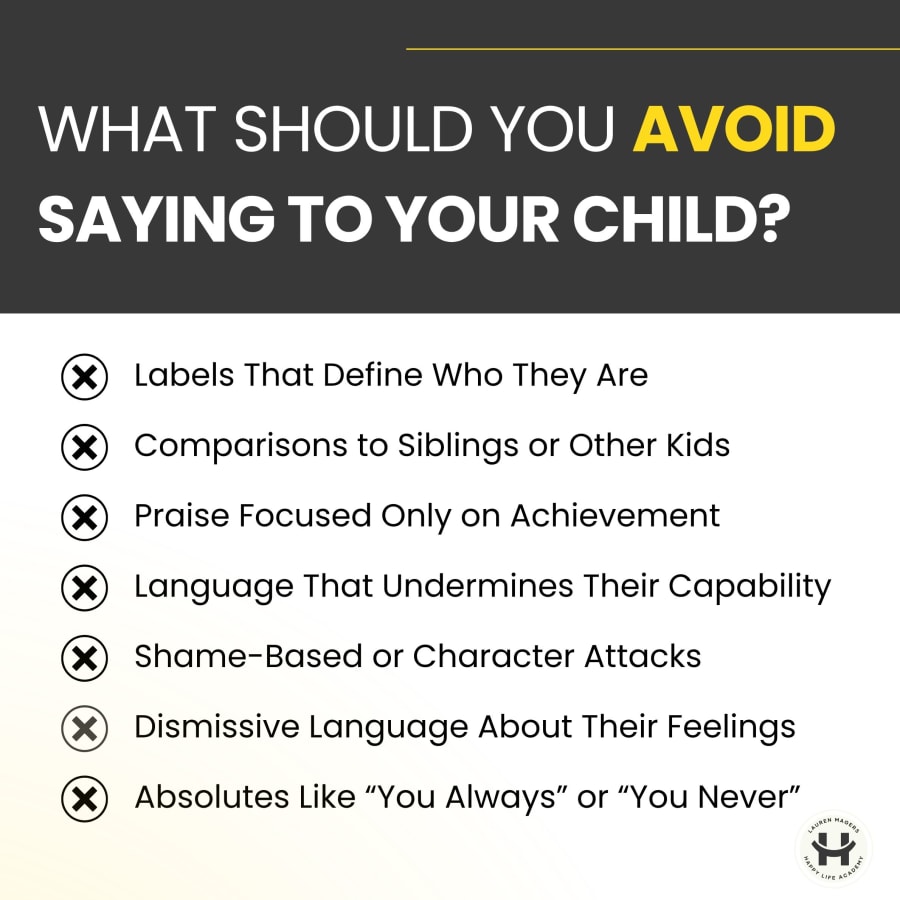
Those are the ones worth paying attention to. Take some time to evaluate what you say in between the praise, especially when you’re frustrated, rushed, or disappointed. Here are some of the things you should avoid saying to your kids, and why they can do more harm than you think:
Labels That Define Who They Are
Be careful with labels like “lazy,” “dramatic,” “difficult,” or “shy.” When kids hear the same label repeatedly, they can accept it as part of who they are. You’ve got to address the behavior without turning the behavior into their identity.
Comparisons to Siblings or Other Kids
“Why can’t you be more like your brother?” might seem motivating, but comparison teaches kids to measure themselves against someone else. Help your child become the best version of themselves, not a carbon copy of somebody else they believe you like better.
Praise Focused Only on Achievement
Celebrate the win, the A, and the big accomplishment, but don’t let achievement become the only time your child hears praise. Positive parenting means recognizing more than results. Notice their effort, courage, growth, kindness, problem-solving, and character too. Even better, praise those things before you know the outcome.
Language That Undermines Their Capability
Watch how quickly you say things like “You can’t do that,” “Let me do it,” or “You’re too young.” Constantly stepping in can communicate that you don’t believe your child is capable. Give them opportunities to struggle, problem-solve, and surprise you.
Shame-Based or Character Attacks
Be careful not to turn something your child did into a statement about who they are. A child who tells a lie isn’t “a liar.” A child who acts selfishly isn’t “selfish.” And a child who makes a poor choice isn’t “irresponsible.” Correct the behavior without assigning your child an identity you don’t want them to carry.
Dismissive Language About Their Feelings
“You’re fine,” “Stop crying,” or “It’s not a big deal” can be dismissive when your child is genuinely upset. But acknowledging their feelings doesn’t mean every reaction needs to be prolonged. There’s a balance between validating emotions and teaching resilience. Give them space to feel, then help them move through it: “I know that hurt, and you’ve had time to be upset. Now it’s time to get back up and keep going.” The goal is to teach kids that they can feel something deeply without letting that feeling take over.
Absolutes Like “You Always” or “You Never”
“You never listen.” “You always make a mess.” Absolutes turn one behavior into a story about who your child is. Talk about what happened right now and what needs to happen next instead of defining them by a pattern you don’t want repeated.
How to Praise a Child Without Creating Pressure
Though there’s plenty of research showing that praise can help build a child’s self-esteem and motivation, there’s another side of it to be aware of. Used the wrong way, positive words can actually create pressure to perform.
Imagine you work in sales and have an incredible month. You blow past your quota, and your boss says, “This is why you’re my top salesperson. You always deliver. I never have to worry about you missing your numbers.” At first, that feels amazing. But what happens next month when sales are slow? Suddenly, you’re not just trying to hit your goal. You’re trying not to lose the identity your boss just gave you.
Kids can experience praise the same way. When they constantly hear “You’re so smart,” “You’re the best player on the team,” or “You always get straight A’s,” success can start to feel like something they have to keep proving. The praise was positive, but the pressure attached to it wasn’t.
The goal of praise isn’t to give your child a standard they have to live up to. It’s to help them recognize their effort, character, growth, and capability without making their value dependent on what they achieve. Here’s how:
- Praise effort, not just outcomes.
- Be specific about what you noticed.
- Recognize character, not just achievement.
- Celebrate progress instead of perfection.
- Acknowledge contribution and responsibility.
- Avoid comparing them to other children.
- Don’t make every accomplishment a big deal.
- Let them own their success.
- Ask how they feel about what they accomplished.
- Separate your love from their performance.
How Positive Communication Strengthens Your Relationship With Your Child
In parenting, sometimes we view productive, positive communication as anything that gets you the desired outcome. So, telling or asking your child to pick up their toys or be nice to their siblings in a way that results in that outcome is good, right? Maybe, but that’s only part of it.
You and your child only have good communication if you BOTH feel seen, heard, respected, and emotionally safe. Kids can learn really quickly how to comply just to keep the peace. But harsh words, constant criticism, or big threats won’t build your child’s confidence, emotional intelligence, self-belief, or sense of identity. And they definitely won’t strengthen your parent-child relationship.
What you need is to take the initiative and intentionally speak life into your child. Don’t wait for them to accomplish something before you tell them what you see in them. Don’t wait until they’re struggling to remind them they’re capable. And don’t assume they already know how grateful you are for their presence in your family. Say it.
Tell them they’re capable. Name the qualities you admire in them. Remind them of their purpose. Point out their growth. Tell them what they contribute to your family. Give them words they can carry with them long after the conversation ends.
Because positive communication isn’t only about how you respond to your child. It’s about intentionally creating a home where encouragement, belief, gratitude, and connection are spoken out loud. The more your child hears those things from you, the more deeply they know you see them, believe in them, and genuinely value who they are.
For more ways to truly connect with your kids and elevate your home to the gold standard of how a family lives, leads, and functions, start with my free Family Operating System™ quiz. In just a few minutes, you’ll see where your family is getting stuck and how Lauren Magers’ Happy Life System™ can bring more encouragement, connection, and peace into your home. Then you can book a call to map out your next step.
Take the quiz. Build the system. Change everything.
How to Speak Positively to Your Child: FAQs
How can I build my child’s confidence?
Building kids’ confidence starts with helping them recognize what they’re capable of. Point out their effort, resilience, character, problem-solving, and ability to handle hard things.
What should I say when my child makes a mistake?
Focus on what they can learn instead of making them feel ashamed. Try, “Mistakes happen. What did you learn?” or “What can you do differently next time?” This teaches them that a bad choice doesn’t define who they are.
How do I encourage my child without praising everything they do?
Use encouraging words when you genuinely notice effort, growth, responsibility, kindness, problem-solving, or contribution. You don’t need to celebrate every little thing to make your encouragement meaningful.
Can you praise a child too much?
Praise can become unhelpful when your child feels like they have to keep performing to earn your approval. To support healthy child self-esteem, focus on effort, growth, character, and progress rather than only achievements.
How can positive words affect a child’s self-esteem?
The words children hear repeatedly can influence how they see themselves and what they believe they’re capable of. Reminding your child that they are valued, capable, resilient, and loved can help them develop a healthier sense of who they are.
Your words have the power to instantly raise your child’s quality of life.
The words you speak today can become the voice your child carries with them tomorrow. So be intentional. Speak life into them, remind them who they are, and never underestimate how powerful a few meaningful words can be.
For more positive things to say to your kids, family leadership tips, and practical ways to raise confident, world-ready humans, follow me on Instagram!

Written by
Lauren Magers
Lauren Magers is a parenting coach, author, entrepreneur, and mom of four. For 15+ years she has applied business and leadership systems to family life, and she created the Happy Life System™ and its Family Operating System™, which have reached 200,000+ lives in 35+ countries.
More about Lauren