
Reduce screen time, set better boundaries, and end daily screen battles.
Tablets and iPads often seem pretty harmless when you first introduce them to your kids. Maybe you handed them a device to get through a road trip or a long dinner. Maybe you used it to help them learn to talk or reach another milestone. Or maybe you tossed it their way to get a much-needed break from all the chaos and dysfunction. Then, almost without realizing it, that quick solution became a habit.
That habit then turned into dependency . . .
And maybe even a screen addiction.
And before you even realized what was happening,
screens quietly started shaping how your kids behave, connect, and spend their time.
First of all, this isn't to shame you. It can happen SO fast, and until pretty recently, we didn't fully understand the potential negative effects of iPads, tablets, and other digital devices on our kids. But once you recognize that screens have taken up more space in your family's life than you want them to, you can change the pattern. You need to change the pattern.
If this is you, it’s time to reset your family's relationship with technology. It’s time to put screens back where they belong: as tools that support your life, not vices that control it.

Screen Time Boundaries: Why They’re So Important
We’re raising kids in a world none of us grew up in, and technology has worked its way into almost every part of their lives. But we can’t afford to look the other way. The risks go far beyond wasted time or a little less face-to-face interaction. Kids now have unprecedented access to addictive content, strangers, algorithms, artificial intelligence, and entire digital worlds designed to keep them coming back for more.
The consequences can be terrifying and, in some cases, absolutely devastating. That’s why taking back control of the role screens play in your home may be one of the most urgent things you can do for your kids right now.
Not tomorrow.
Not someday.
Right now.
Because none of this is happening by accident. Every scroll, notification, short-form video, and burst of fast-paced digital stimulation activates the brain’s reward system, delivering another quick hit of stimulation. Then, before you know it, our kids’ brains get so used to those constant rewards that everything else feels harder. Focusing. Being bored. Working through discomfort. Waiting for something they want. Sticking with something when the return isn’t immediate.
And those are the exact skills our kids need to become confident, resilient, disciplined, world-ready adults. This isn’t just about getting your kid off an iPad. It’s about protecting who they’re becoming.
But, as you probably already know, cutting back on excessive screen time isn’t as simple as donating the iPad or putting parental controls on the game console. Take away a device your child has grown dependent on, and you may be met with meltdowns, bargaining, anger, boredom, or nonstop requests to get it back.
So, how do you reduce screen time for kids without the tantrums, power struggles, and constant battles? That’s exactly what we’re going to tackle together today.
Watch: My Instagram reel on cutting back screen time
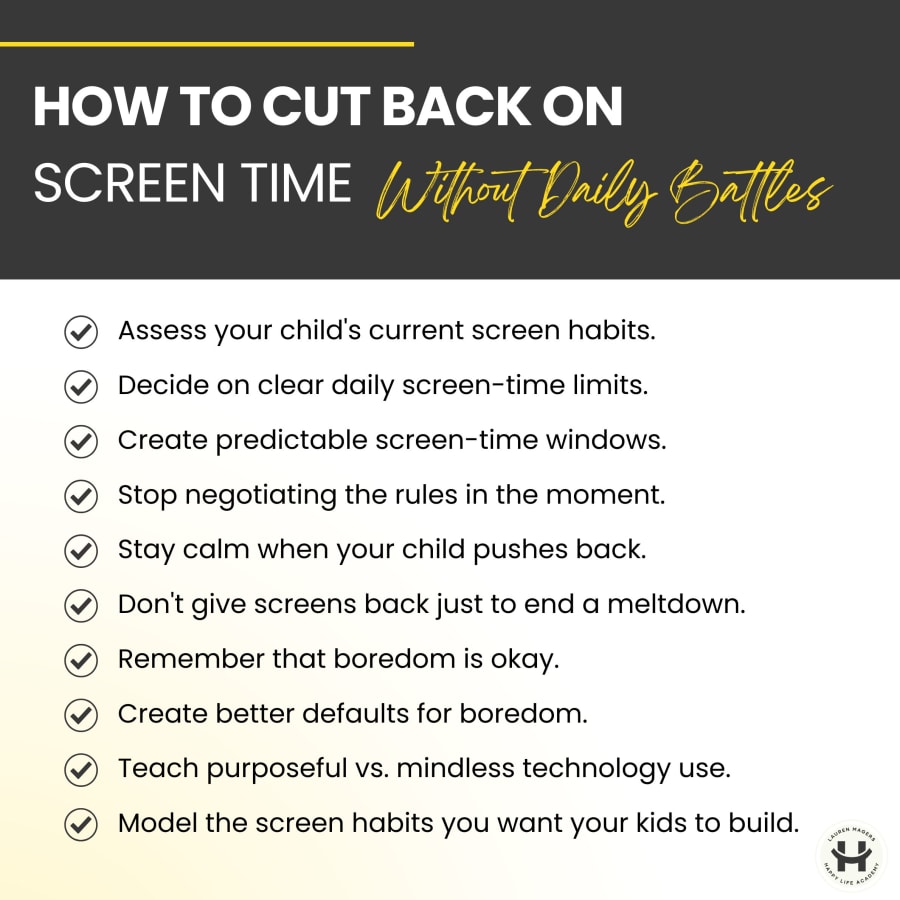
How to Cut Back on Screen Time Without Daily Battles
Whether you want to decrease your kids’ screen time or become a totally screen-free home, the steps are the same. Video games, endless Reels, overstimulating YouTube content, addictive apps, and constant digital entertainment keep kids passively consuming instead of actively engaging with real life. To break that cycle, you have to do more than take the screens away. You have to show them how to come alive without them.
Here’s how to do it without turning every day into a battle:
Assess your child's current screen habits.
Before you change anything, get honest about where you are. How much time is your child actually spending on screens each day? What are they doing during that time? Are they intentionally choosing something to watch or play? Or automatically reaching for a device anytime they're bored?
Most importantly, pay attention to what happens when the screen goes away. Bargaining, anger, shutting down, sneaking devices, or immediately asking when they can have it back can tell you a lot about the role technology is playing in their life. Look at what screens may be replacing too, like sleep, responsibilities, relationships, movement, creativity, and real-world experiences. You need to understand the pattern before you can lead your child out of it.
Decide on clear daily screen-time limits.
Once you understand the pattern, decide what the new standard will be. How much recreational screen time are you comfortable with? Which devices and activities count? Are there different expectations for weekends, schoolwork, or family movie nights? Don't make these decisions in the moment based on how tired you are, how much you need to get done, or how loudly your child is screaming.
Decide what makes sense for your family ahead of time, communicate it clearly, and commit to it. You CAN’T budge. The minute your child realizes it’s up for debate, the protesting will never stop. You’ve got to stick to it no matter what. Even if you’re exhausted, overstimulated, or sick. It’ll be so worth it in the end!
Remember, the goal isn't to create a bunch of arbitrary family rules. It's to put technology back in its proper place so your kids aren't deciding all day long when, where, and how much they consume.
Create predictable screen-time windows.
A daily limit is much easier to maintain when your kids also know when screen time happens. If you don’t have that set window, you’ll spend all day answering, "Can I have my iPad now?" Instead, give screens a predictable place in your family's daily routine. Maybe after lunch your kids pick up their toys and get a set amount of screen time. Or maybe while you’re cooking supper they get their devices assuming they completed their schoolwork.
Outside of those times, screens just aren't an option. The exact schedule will look different for every family, but the predictability matters and makes the transition much easier for everyone. It removes some of the constant decision-making for you and uncertainty for your kids. Instead of technology being available whenever boredom strikes, it becomes one small, intentional part of a much bigger day full of exploration, creativity, and connection.
Stop negotiating the rules in the moment.
If the rule changes every time your child asks, argues, bargains, or promises "just five more minutes," it isn't really a rule. Decide your standards before emotions are high and then follow through when the moment comes. That doesn't mean you have to become cold or controlling. You can listen to your child's disappointment, acknowledge that they want more time, and still hold the boundary.
The more consistently you do this, the less reason there is for your child to keep testing whether today's "no" might eventually become a "yes." You're moving your family away from reactive parenting, where every screen interaction becomes another decision or battle, and toward clear leadership your kids can actually predict.
Stay calm when your child pushes back.
Let’s be honest, your child probably won’t be thrilled with these changes. This is especially true if they’ve gotten used to completely unrestricted access to screens. Expect some pushback. They may argue, cry, yell, whine, or tell you that everyone else's parents let them do it. Their reaction doesn't mean you've made the wrong decision. And you don't need to match their intensity, launch into a lecture, or convince them to agree with you.
Your job as the intentional leader in your home is to stay grounded, hold the boundary, and help your child work through the discomfort of not getting what they want. Trust me, I know this is hard to do. One of the best ways to keep yourself from getting pulled into the meltdown is to plan for it ahead of time. Decide what you’re going to say, how you’re going to respond, and what you’ll do if things escalate. And remember, it’s okay to step away for a minute if you feel yourself starting to lose your cool. You don’t have to participate in the tantrum to hold the boundary.
Don't give screens back just to end a meltdown.
This may be one of the hardest parts of changing your family's screen habits. When your child is yelling at the top of their lungs and trashing the living room, everyone is miserable. Handing the iPad back can feel like the fastest way to restore peace. But if a meltdown repeatedly results in more screen time, you're reinforcing the exact pattern you're trying to change. Your child correctly learns that enough resistance or disruption will eventually get them what they want. And that attitude doesn’t just apply to screen time. They’ll take it to school, activities, Grandma’s house, and eventually, the workplace.
There is nothing more important you can do in that moment than hold your boundary and let them be uncomfortable. This isn’t mean. You’re teaching them that they can feel angry, disappointed, or frustrated without those feelings changing the outcome. They can work through discomfort, regulate their emotions, and eventually move on. And every time they do, they’re learning that they don’t need a screen to escape a feeling they don’t like. Every time you get through a meltdown without giving in, you’re winning your child’s future back.
Remember that boredom is okay.
One of the biggest mindset shifts you may need to make has nothing to do with your child. You have to stop believing it's your job to keep them entertained. Boredom isn’t an emergency. It’s not even a bad thing! (Read my post on the joy of boredom.) When you finally allow your kids to be bored, you’ll be amazed by what comes out of it. Their best ideas, biggest bursts of creativity, and most imaginative play often happen when their brains are forced to search for something to do. Give them the space to figure it out instead of immediately filling that space for them.
That said, if your kids have been dependent on digital devices for a long time, this won’t come easily to them at first. They’ll probably struggle with the quiet and lack of stimulation. Simply put, they haven’t really learned to play or engage their minds if there was always a screen entertaining them. It’ll take them a while to gain that skill, and that’s okay. Let them be bored. Let them sit and stare at the wall or wander outside with nothing to do. It may feel frustrating for everyone in the beginning, but eventually, they’ll start finding ways to fill that space on their own. And every time they do, they’re learning how to create their own fun, follow their curiosity, and figure out what to do with their time without a screen doing all the work for them.
Create better defaults for boredom.
Letting your kids be bored doesn’t mean leaving them completely on their own to figure it out. Especially in the beginning, they may need a little help remembering what life without constant digital entertainment even looks like. You can support that process without becoming responsible for entertaining them.
Start by making opportunities for real-world play easy to see and easy to access. Get them outside. Leave out art supplies, books, games, puzzles, or building materials. Give them responsibilities. Cook together. Encourage them to start a project, pick up a hobby, call a friend, ride their bike, build a fort, jump on the rebounder trampoline, or wander into the backyard and see what they find. You’re not planning every minute of their day. You’re simply opening their eyes to all the things they could be doing instead of reaching for a screen.
Teach purposeful vs. mindless technology use.
Not all screen time is created equal, and that's an important distinction for kids to understand. A child using a computer to research something they're fascinated by, learn a skill, create music, or type a letter to their pen pal isn't having the same experience as a child mindlessly scrolling through whatever an algorithm serves up next.
Start helping your kids recognize that difference. Before they pick up a device, encourage them to know why they're using it. Are they going online to create, learn, or accomplish something? Or are they reaching for stimulation because they don't know what else to do? We’re not trying to raise kids who just follow your screen rules.
The goal is to raise kids who treasure every moment, protect their attention, and understand that how they spend their days is shaping who they become. Eventually, we want them to choose a life of purpose, growth, and real-world experiences because they recognize that their time and potential are too valuable to mindlessly give away.
Model the screen habits you want your kids to build.
Finally, take an honest look at your own relationship with technology. It's hard to teach your kids that every quiet moment doesn't need to be filled with a screen if you're checking your phone every chance you get. They notice when you're scrolling during conversations, answering notifications during dinner, checking social media during a movie, or carrying your phone from room to room.
That may sound convicting, but here's the thing: They also notice when you intentionally put it away. You don't have to model perfection, and adults obviously use technology for responsibilities kids don't have. But let your children see what intentional technology use looks like. Let them see you be bored, be present, have conversations, work, create, rest, and enjoy your life without constantly reaching for a device.
This is how you step back into your power as the leader of your home. You stop letting technology decide where your attention goes and start choosing for yourself. And when your kids watch you protect your time, focus, and energy for the things that actually matter, you're showing them how to do the same.
Why iPads and Tablets Feel More Addictive Than TV
It’s up to you to decide what technology use looks like in your home. For some families, tablets and iPads are off the table, but intentional TV time is okay. Others choose to go completely screen-free. And some families are comfortable with a little bit of everything in moderation. You get to determine your family’s routines and standards. But whatever you decide, make sure you understand how different types of screen time actually affect the brain.
If you’re a Gen Xer or Millennial, you probably grew up with the TV on a lot. In some ways, our culture was even more centered around television back then. When the M*A*S*H finale aired in 1983, around 105 million people tuned in, representing 77% of everyone watching television that night. Families planned evenings around their favorite shows. Friends talked about episodes the next day. You had to be in front of the TV at a certain time or you simply missed it.
Why do I bring this up? Because you probably don’t feel like that television experience prevented you from fully experiencing your childhood. You played outside until the streetlights came on. You fished. You swam in creeks. You talked to friends for hours on the phone. You wrote stories. You played pretend. So why didn’t TV rot your brain like your teachers warned it would?
Because the television we grew up with created a very different experience than what kids can access on an iPad or tablet today.
How iPads Affect the Brain Differently Than TV
For starters, tablets create much faster reward loops. With traditional TV, you mostly sit back and watch. Something exciting might happen, but you have to wait for it. On a tablet, almost every action can produce an immediate response. Tap something and it moves. Beat a level and you get a reward. Swipe and a brand-new video appears. The brain quickly learns that one tiny action can immediately deliver something interesting.
Those rewards can also be unpredictable. Your child doesn’t know whether the next Reel will be boring or hilarious, what they'll unlock in a game, or what will happen when they swipe again. That unpredictability creates what’s known as variable reinforcement. The possibility that the next thing could be really good keeps them coming back for another one.
Why Short-Form Content Is So Hard for Kids to Put Down
Kids also have much more control over their stimulation than we did with traditional TV. If an episode got boring for a few minutes, we usually just sat through it. On an iPad, your child doesn't have to tolerate that boredom. They can skip the video, swipe to another one, replay the exciting part, switch games, open another app, or search for exactly what they want.
Then you add algorithms into the mix. Your child’s digital feed can become increasingly personalized based on what they click, skip, watch, replay, and engage with. Instead of simply watching whatever happens to be on, they're continually served more content selected specifically to keep their attention.
Why Kids Have a Hard Time Stopping Screen Time
Traditional television also gave us natural stopping points. An episode ended. Credits rolled. The next show might not interest us. Eventually, there was a reason to get up and do something else.
Many digital platforms remove those stopping cues. One video autoplays into another. One level leads to the next. Or one Reel becomes another with a single swipe. And if one activity gets boring, your child can simply switch from YouTube to Roblox to Snapchat without ever putting the device down.
How Screens Can Become a Coping Mechanism for Kids
Over time, the device can even become associated with relief from uncomfortable feelings. Bored in the car? Grab the iPad. Upset after school? Watch YouTube. Waiting at a restaurant? Play a game. Nothing to do? Start scrolling.
When that happens over and over, kids reach for technology automatically whenever they feel bored, frustrated, restless, or uncomfortable. The screen isn't just entertaining them anymore. It's becoming their default response to feelings and situations they haven't learned to navigate without it.
Why Real Life Can Feel Boring After Too Much Screen Time
And this is where things get especially important. Real life requires kids to wait for rewards. Building something takes effort. Learning an instrument can be frustrating. Reading requires sustained attention. Playing outside requires figuring out what to do. Even having a conversation means tolerating moments that aren't particularly exciting.
An iPad can offer something completely different: novelty now, entertainment now, feedback now, something new NOW.
That’s why taking away a tablet can feel so different from turning off the television we grew up with. TV entertained us. Today’s tablets can create a constant loop of choosing, tapping, swiping, earning, skipping, and searching for the next reward.
How Too Much Screen Time Changes Children's Behavior
You turn off the iPad and suddenly everything is a problem. Putting on shoes is too hard. Their sibling is too annoying. They’re bored five minutes into playing outside. You ask them to clean their room and they act like you’ve asked them to climb Mount Everest. Every “no” becomes an argument, every transition becomes a battle, and nothing in the real world seems quite exciting enough.
That’s the bigger concern with excessive screen time. We’re training kids to expect constant stimulation in a world that requires patience, effort, focus, and discomfort. Real life asks them to wait their turn, finish the boring assignment, work through conflict, solve their own problems, and keep going when something gets hard.
We don’t just want kids who can put down an iPad without a meltdown. We want kids who can walk into the real world awake, engaged, resilient, and ready to participate in their own lives.

Signs Your Child Is Spending Too Much Time on Screens
- Anger, frustration, or arguments erupt when screen time ends.
- Constant requests for a phone, tablet, TV, or other device become part of the day.
- Putting a device down requires repeated reminders or negotiation.
- Boredom immediately leads to reaching for a screen.
- Favorite hobbies, toys, outdoor play, or other activities become less interesting.
- Time with family or friends takes a backseat to digital devices.
- Independent play becomes difficult without digital entertainment.
- Chores, schoolwork, or other responsibilities start getting ignored.
- Sleep habits suffer because of late-night or excessive screen use.
- Shifting attention away from a device becomes increasingly difficult.
- Frustration, boredom, or discomfort feels harder to tolerate without stimulation.
- More time is spent scrolling, gaming, or watching content without a clear purpose.
- Sneaking devices or breaking established screen-time rules becomes common.
- Screen-time limits regularly trigger bargaining, arguments, or meltdowns.
- Technology becomes a primary way to cope with stress or uncomfortable emotions.
- Family routines increasingly revolve around access to devices.
- Relationships, responsibilities, sleep, or everyday activities begin to suffer.
How to Reduce Screen Time for Kids: FAQs for Parents
Still feel like you need more guidance managing your children’s screen time? I’m here to help! When you join Happy Life HQ™, you get access to my complete Family Operating System™. It’ll help you take all the information you learned here (and more) and actually download it into your home.
And you won’t just be solving your screen-time issue. This revolutionary, fail-proof system helps you change the patterns underneath so many of your family's everyday struggles. Instead of putting out one fire after another, you’re building a family that knows how to communicate, contribute, solve problems, handle hard things, and move forward together.
But until you’re ready to dive in, here are some of the most common questions parents ask about reducing screen time and creating healthier technology habits at home:
Are iPads bad for kids?
Not necessarily. iPads are tools, and how kids use them matters. Problems are more likely when screens become excessive, replace real-world experiences, or become a child's default source of entertainment and emotional regulation.
How much screen time is healthy by age?
According to the American Academy of Pediatrics, screen-time limits can vary based on your child and family, but general guidelines include:
- Babies: The AAP notes that infants don't learn from digital media, although occasional brief, high-quality videos aren't considered harmful
- Toddlers and preschoolers: Less than 1 hour per day may be appropriate
- School-aged kids and teens: Around 1–2 hours per day or more of entertainment screen time may be appropriate, depending on the child and family
The AAP emphasizes that quality matters just as much as quantity. Screen time shouldn't crowd out sleep, physical activity, reading, play, or other important parts of childhood.
And remember, these are guidelines, not goals. Your child doesn't need an hour or two of screen time just because the recommendation allows for it.
At what age should kids get a tablet?
If you ask me? Never. Kids don’t need their own tablet to learn, grow, create, or have an incredible childhood. That said, I know every family is different, and you get to decide what technology looks like in your home. If you do introduce one, make sure you are setting the standard for when, why, and how it gets used, not handing over unlimited access and hoping your child learns to regulate it.
What is the best alternative to screen time?
Real life! Get kids outside, reading, creating, building, helping around the house, pursuing hobbies, spending time with friends, or simply figuring out what to do when they’re bored. You don’t need to replace an iPad with nonstop entertainment. Give them opportunities to discover what actually interests them.
Should parents use screen time as a reward?
I wouldn’t. Think about the message that sends: Do this boring chore, read this book, play outside, finish your homework, and then you can have the thing you really want. You’ve accidentally made the screen the prize and real life the work required to earn it. Instead, give technology a clear, intentional place in your family without putting it on a pedestal.
Can too much screen time affect behavior?
Yes. A large systematic review and meta-analysis published in JAMA Psychiatry looked at 87 studies involving more than 159,000 children and found that greater screen time was associated with higher levels of externalizing behavior problems, including aggression and inattention, as well as internalizing problems like anxiety and depression. The associations were small, so this doesn’t mean screens automatically cause these behaviors, but the connection is worth paying attention to.
Does screen time cause attention span problems?
The research definitely shows a connection. Most studies have found the same basic pattern: the more time kids spend on screens, the more likely they are to struggle with paying attention. More research is needed before we can say that screen time directly causes attention problems, but the connection alone is strong enough that parents should take it seriously.
What are the benefits of less screen time?
You're not just getting hours back. You're giving childhood back. Suddenly there's time to climb trees, make things, talk to you, fight with siblings and work it out, get bored, discover interests, contribute around the house, move their bodies, and figure out who they are. Less screen time creates more space for the experiences that actually develop your child.
How long does it take for kids to adjust to less screen time?
It will probably take your kids a few weeks to adjust to your family’s new screen-time boundaries. The first few days will likely be the hardest, and if your kids are used to several hours of daily device use, it may take a couple of months or more for the new routine to feel completely normal. Don’t mistake that resistance for a sign that it isn’t working. Stay consistent, give them time to adjust, and remember that you’re replacing a pattern they may have practiced every single day for years.
What happens when kids have less screen time?
At first? They may drive you absolutely crazy. Your kids will wander around and whine. They’ll have plenty of meltdowns. And they'll ask what they're supposed to do 1,000 times a day. Let them. Mentally prepare for it. The only way out is through.
Within a few weeks or months, they’ll start to play, create, explore, contribute, think, connect, and discover in the way you did as a child . . . in the way you always dreamed they would. You always knew your kids were made for more. You just couldn't figure out how to unlock that incredible potential. Who knew that sometimes, all they needed was a little more space, quiet, and boredom to finally tap into it?
Take back your family’s time, attention, and potential.
Screens aren’t going anywhere. But that doesn’t mean they get to decide how your kids spend their childhood or who they become. You get to set a new standard in your home, and even if the first few days are messy, what’s waiting on the other side is worth fighting for.
And remember, screen time is only one piece of the puzzle. If you’re ready to stop fighting one battle at a time and start changing the bigger patterns in your home, start with my free Family Operating System™ quiz. In just a few minutes, you’ll see where your family is getting stuck and how Lauren Magers’ Happy Life System™ can help you reclaim your peace and raise thriving, world-ready kids. Then you can book a call to map out your next step.
Take the quiz. Build the system. Change everything.

Written by
Lauren Magers
Lauren Magers is a parenting coach, author, entrepreneur, and mom of four. For 15+ years she has applied business and leadership systems to family life, and she created the Happy Life System™ and its Family Operating System™, which have reached 200,000+ lives in 35+ countries.
More about Lauren
