
Build intrinsic motivation through ownership, contribution, and follow-through.
Please stop forcing your kids to do stuff.
Do their homework.
Clean their room.
Take out the trash.
Rush out the door to the next activity.
When you’re constantly demanding immediate action, you’re actually inviting resistance. It’s likely one of the reasons your home feels so chaotic and dysfunctional. But don’t think I’m advocating for gentle parenting or letting your kids do whatever the hell they want. That’s definitely not the solution!
Here’s the thing: Peaceful homes aren’t harmonious because those kids just “listen better” or the parents do everything to keep the peace. Families don’t create a calm environment where everyone takes ownership by accident, by force, or by luck. To raise capable, self-motivated children, you need to be intentional and consistent.
So, how do you stop forcing your kids through every responsibility without lowering your expectations? That’s what I’m discussing today. Here’s how to develop intrinsic motivation in children:
Watch: Lauren’s post on Instagram
What Is Intrinsic Motivation?
Intrinsic motivation is the internal desire to act because something feels meaningful, satisfying, or connected to who you believe you are. For kids, it grows when they feel capable, valued, and proud of the role they play, not when you’re standing over them with a piece of candy, the threat of a big consequence, or the same reminder you’ve already given seventeen times.
Now, does that mean your child will suddenly skip joyfully toward the overflowing trash can because contributing to the family fills their soul? Probably not. But it does mean they can learn to see themselves as an important part of something bigger. Their responsibilities aren’t random chores designed to ruin their fun. They’re opportunities to practice ownership, build confidence, and become the capable, world-ready human they were always meant to be.
Intrinsic motivation for kids is really about helping them connect who they are today with who they want to become. Suddenly, they put the pieces together: “If I practice being kind, I can build strong friendships everywhere I go. If I learn to manage money and follow through on my ideas, I could start my own bracelet business next summer. If I practice sharing my ideas, solving problems, and taking feedback, I could land my dream job as a fashion designer someday.” That’s when it clicks: What I do right now is actually preparing me for the life I want later. The responsibility in front of them stops feeling like some random thing you’re forcing them to do and starts feeling like practice for their future.
Intrinsic vs. Extrinsic Motivation
When talking about motivated kids, you may just think, “Yeah, motivated is motivated. It doesn’t really matter why.” Oh, but it does. It really matters. First, let’s talk about the two types of motivation.
Extrinsic Motivation
This is the type of motivation you’ll see a lot in other parenting resources. Think sticker charts, candy, money, added privileges, etc. It could also be the threat of punishment. Extrinsic motivation happens on the outside. Whether by bribing children, applying pressure, laying out a consequence, or offering a reward, extrinsically motivating kids means driving your kids to comply through an external incentive or consequence. Basically, the child thinks, “I’ll do this because of what I’ll get or what will happen if I don’t.”
Intrinsic Motivation
This kind of motivation is harder to instill in your children, but it’s so much more valuable. Intrinsic motivation comes from within. The child does something because of something on the inside. It makes them feel satisfied, it has meaning, it’s interesting, or it just aligns with their values and who they want to be as a person. Instead of asking, “What will I get if I do this?” they ask, “Why does this matter to me?” That’s the kind of motivation that helps kids take initiative, make good choices, and follow through even when no one is watching or offering a reward.
Why Rewards, Bribes, and Force Don’t Create Lasting Motivation
You may be asking yourself what’s really so bad about using external incentives and consequences. The truth is, extrinsic motivation isn’t inherently bad when a child already has a strong sense of intrinsic motivation. The problem comes when you rely on a dollar for good behavior, a piece of candy for listening, or the threat of losing screen time to make your child comply.
Over time, this teaches kids to evaluate every decision by asking:
What do I get if I do this? What will happen to me if I don’t?
It doesn’t establish values, character, or willpower within them. It simply makes them compliant in the moment because they want to gain something or avoid something.
Why Rewards and Punishment Eventually Lose Their Power
Here’s where the problem starts. Eventually, the candy bar isn’t enticing enough. Losing TV for the weekend doesn’t seem so bad. The reward that worked yesterday no longer gets the same response today. So, as the parent, you’re stuck offering bigger rewards or harsher punishments just to get your child to cooperate. Meanwhile, your child learns to push the boundaries and hold out for a better “deal.”
Now, I am all for raising entrepreneurial kids, but that’s not what this is. This teaches children that the world should always give them something in exchange for making a good choice. But we know that’s not how the real world works. Good deeds often go unnoticed. Many of the decisions we make throughout the day are just good for our minds, bodies, relationships, and souls. There is no applause, prize, or immediate return on investment.
P.S. That’s also why I don’t pay my kids for standard household duties. Learn more about that in my post, “Should Kids Have Chores?”
How to Motivate Kids Without Rewards
What your child needs first is intrinsic motivation; they need to value making the right choice regardless of what happens afterward. They tell the truth even when admitting what they did means facing a consequence. They include the child sitting alone because kindness matters to them. And, they finish their responsibility without being reminded because they understand that their contribution affects the entire family.
Can you reward those choices after the fact? Absolutely. A surprise reward can reinforce the behavior without making the action dependent on it. Sometimes, you’ll celebrate with something special. Sometimes, they’ll get a pat on the back. Other times, no one will notice what they did at all.
But actually, they still get something.
They gain self-respect. Confidence. Discipline. Integrity. Stronger relationships. Greater independence. The satisfaction of knowing they followed through. Most of all, they become the kind of person they want to be.
With intentional parenting, we can teach kids to value those rewards more than any toy, privilege, or amount of money.
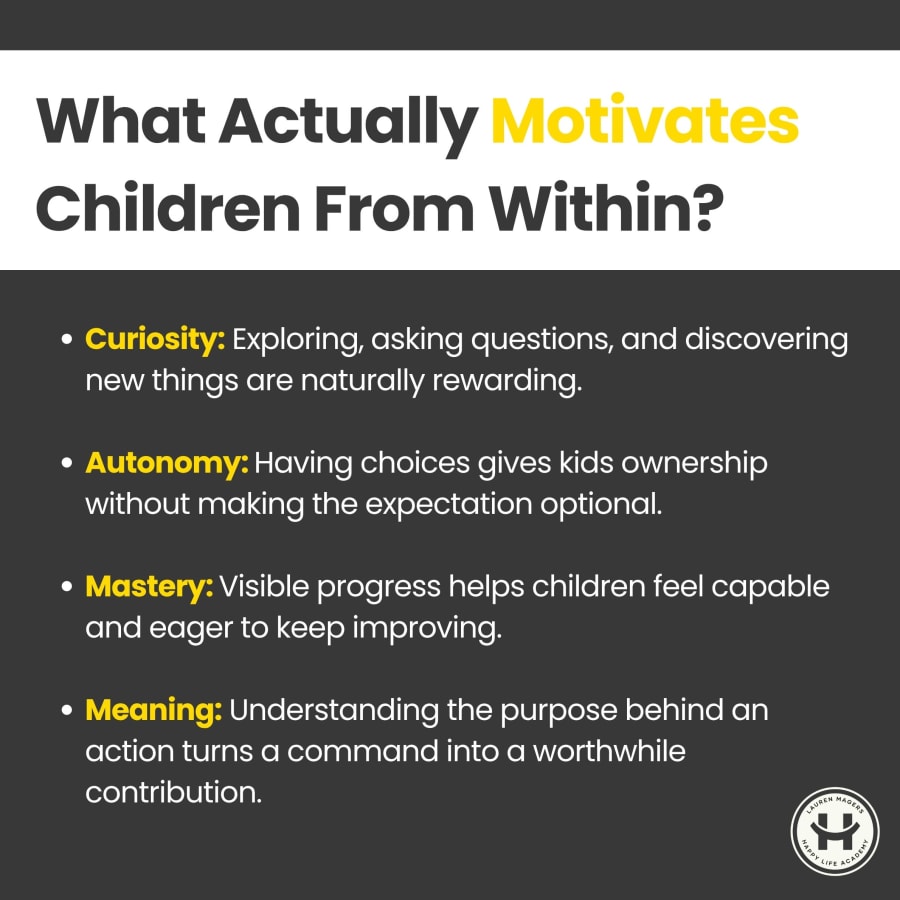
What Actually Motivates Children From Within?
In my experience, lasting motivation grows when we stop asking, “How can I make my child do this?” and start asking, “What would make my child want to take ownership of this?” When I look at what naturally draws kids in and inspires them to keep going without being bribed, threatened, or chased down, I see four powerful forces at work:
- Curiosity: Kids are naturally driven to explore, ask questions, experiment, and discover how things work. When something captures their interest, learning or participating becomes rewarding on its own.
- Autonomy: Children are more motivated when they have some ownership over how they complete a task. Age-appropriate choices allow them to exercise independence without making the expectation itself optional.
- Mastery: Kids want to feel capable. Seeing themselves improve, solve a problem, or complete something they once found difficult creates genuine satisfaction and motivates them to keep going.
- Meaning: Children are more willing to act when they understand why their actions matter. Connecting a responsibility to their family, values, relationships, or future goals transforms it from another command into a meaningful contribution.
By connecting everyday responsibilities to your child’s growing sense of ownership, capability, and purpose, you help them develop the internal drive to follow through, even when the task itself isn’t exciting. That’s how you move beyond temporary compliance and begin raising a child who is motivated to take action even when no one is watching.
For more on this, read up on what psychologists call the Self-Determination Theory.
How to Build Intrinsic Motivation in Children
Step One: Start with a Family Operating System™.
Intrinsic motivation cannot thrive in chaos. When every expectation changes by the hour and your kids never know what’s coming next, they learn to wait for instructions instead of taking initiative.
Think about it. Successful businesses, schools, sports teams, and organizations all have operating systems that unite people around a shared vision. Everyone knows where they’re going, what they’re responsible for, and why their role matters. That allows people to work together, contribute their strengths, and feel naturally motivated to help the entire organization thrive. Yet when it comes to the most important team we’ll ever build, our families, we’re somehow expected to wing it.
Your family needs that same kind of clarity. A Family Operating System™ is a clear, repeatable blueprint for how your home functions every day. It starts with the big questions: Who are we as a family? What do we value? Who do we want to grow into together? Then, it turns those answers into the routines, responsibilities, expectations, and communication tools that shape how your family actually lives.
When children can see where the family is going and understand their place within it, their responsibilities no longer feel like random demands handed down by Mom or Dad. They become part of something everyone is building together. Over time, their thinking shifts from “Mom is making me do this” to “This is how I contribute to my family.” This is how we raise a generation that doesn’t wait to be managed, bribed, or rescued, but knows how to take ownership, contribute, and lead.
Step Two: Turn recurring responsibilities into predictable microsystems.
If something happens repeatedly in your home, it needs a microsystem. A microsystem is a structured plan your child follows each time a task or responsibility comes up, outlining what needs to happen, when to do it, and how to get it done.
Instead of waiting until their room is a disaster and then asking them to clean it, establish a microsystem where they reset their room every night before dinner. If you’re constantly fighting with your teenager about when to start homework, establish a consistent time for them to begin each evening. And if you spend every morning micromanaging teeth, clothes, breakfast, shoes, and backpacks, create a step-by-step morning routine your kids can follow independently.
These everyday responsibilities shouldn't require a new set of instructions every time. When the plan is already established, your child knows where to start and what finished looks like. You no longer have to conduct the entire production like a frazzled stage manager, and your kids develop the consistency and independence to follow through on their own.
Step Three: Replace random commands with established family rhythms.
Random commands make children feel like responsibilities are constantly falling from the sky.
“Put your shoes away.”
“Feed the dog.”
“Go brush your teeth.”
“Did you fill your water bottle?”
Instead, build predictable rhythms around what needs to happen and when. Shoes are put away as soon as everyone comes home. The dog is fed before breakfast. Teeth are brushed after pajamas go on. Water bottles are filled during the evening routine. Each responsibility becomes connected to something that already happens every day, so your kids don’t have to wait for you to announce what comes next. These rhythms remove the daily negotiation and allow follow-through to become part of how your family naturally moves through life.
Step Four: Connect each system to a shared purpose.
Children are more motivated when they understand why something matters. Don’t stop at, “Clean the living room because I said so.” Explain that your family believes in being masters of their space. Everyone takes responsibility for caring for the areas they use so your home stays functional, everyone can find what they need, and your family can start each new day with a sense of peace.
Consistently connect each system to the bigger vision for your home. When kids understand how their actions contribute to the peace, order, and quality of life your entire family enjoys, their responsibilities take on a purpose beyond simply obeying you.
Step Five: Position responsibilities as contribution, not favors for the parent.
Your child is not “helping Mom” by putting away laundry, clearing the table, or caring for their belongings. They are contributing to a home they are part of. You need to make that distinction both in your personal mindset and in how you lead your home.
A favor is optional and usually performed for someone else’s benefit. Contribution is part of belonging to something bigger than yourself. When children understand that their actions affect the entire family, responsibility stops being a random demand from an exhausted parent and becomes evidence that they are valuable, necessary members of the team.
For more on household responsibilities, read my post “Should Kids Have Chores?”
Step Six: Give children meaningful roles within the system.
Kids need to know that what they do actually matters. Give them roles with real value instead of invented tasks that keep them busy while you handle everything important. Even a three-year-old can pick up trash, match socks, or put their toys back where they belong. And, an older child can manage the after-school reset, prepare part of dinner, or track when household supplies are running low. Meaningful roles tell your child, “You are capable. We trust you. This family functions better because you are part of it.”
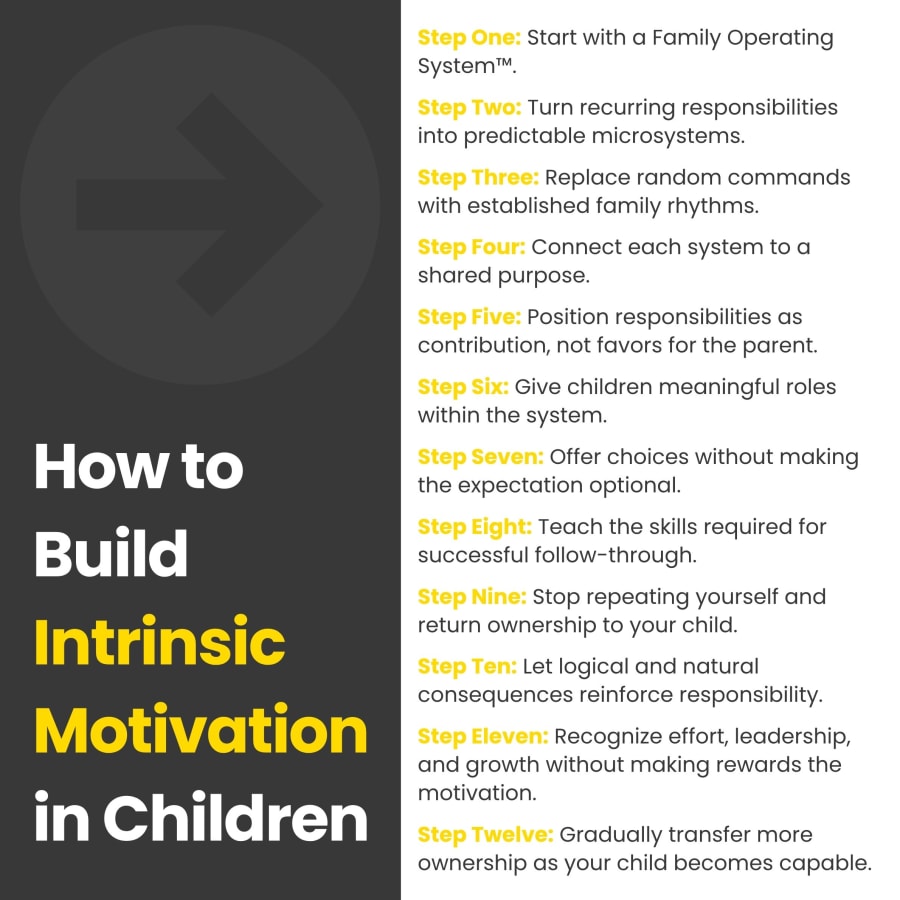
Step Seven: Offer choices without making the expectation optional.
Autonomy does not mean children get to decide whether they will contribute. It means they receive age-appropriate ownership within a clear expectation. In fact, research has found that children whose parents support their autonomy tend to show higher levels of intrinsic motivation toward learning.
With a younger child, you might ask, “Would you like to empty the dishwasher before or after breakfast?” or “Do you want to start with the clothes or the toys?” As kids grow, they can take a more active role in shaping the systems they follow.
Maybe your teenager notices they focus better after dinner and asks to permanently move homework time from right after school to 7:00 p.m. If the new plan still allows them to meet the expectation and works for the family, give them room to try it. The responsibility remains steady, but your child gains more control over how and when they fulfill it. You are still leading your home, but you are also teaching them how to understand themselves, make thoughtful decisions, and lead their own lives.
Step Eight: Teach the skills required for successful follow-through.
Sometimes what looks like laziness, defiance, or a lack of motivation is actually a lack of skill. Your child may not know how to organize a messy room, estimate how long a task will take, regulate their frustration, or recognize what “done” looks like. Slow down and teach the process. Model it, practice it together, and create visual instructions when needed. Children are far more willing to take ownership when they feel capable of succeeding. You can’t expect confident follow-through from a child who has never been shown how.
Step Nine: Stop repeating yourself and return ownership to your child.
Every reminder quietly transfers responsibility back to you. If you always remember the library book, announce the practice time, locate the missing cleats, and ask seventeen times about the trash, your child never has to carry the mental weight of their own responsibilities. Establish the expectation, give them the tools they need, and allow space for them to remember and act. This may feel uncomfortable at first, but constantly rescuing children from ownership keeps them dependent on your voice instead of developing their own.
Here’s more on how to stop repeating yourself with your kids.
Step Ten: Let logical and natural consequences reinforce responsibility.
Okay, so you stop repeating yourself, and your kids drop the ball. What happens then? This is where natural and logical consequences come in. Natural consequences for kids happen without you creating them. If your child forgets their water bottle, they’ll have to use the fountain. If they forget their homework at home, they may have to explain the situation to their teacher.
But some things don’t have a natural consequence that impacts the child, so then it’s time for logical consequences.
Logical consequences require you to step in, but they should still connect directly to the choice. If your child draws on the wall, they help clean it. If they leave their bike in the driveway, they walk to school the next day. In both cases, it’s not about making your kids suffer; it’s about teaching them a gentle lesson.
Here’s the point: A consequence should not be some random punishment you pile on because you’re frustrated. It should make sense. When a choice creates a clear result, you don’t need a ten-minute lecture or another angry speech. The lesson is already sitting right there in front of them. Give your child space to experience it, fix what they can, and decide what they will do differently next time. That’s how consequences build responsibility instead of fear.
Step Eleven: Recognize effort, leadership, and growth without making rewards the motivation.
Notice your child’s progress, but be intentional about what you praise. Instead of making every success about a prize, point out the character and capability you see developing: “You stayed with that even when it was frustrating,” or “You noticed what needed to happen and took care of it without being asked.” This helps children recognize something much more valuable than the gold star. They see themselves as persistent, trustworthy, capable leaders who can make a meaningful difference in the spaces they occupy.
Step Twelve: Gradually transfer more ownership as your child becomes capable.
Think about how strong organizations develop great people. A leader does not teach someone a skill and then hover over their shoulder forever. They provide instruction, offer support, watch them practice, and gradually hand over more responsibility. As that person proves capable, they earn greater trust, more independence, and new opportunities to grow.
Your home should work the same way. As your child becomes more capable, you step back. You stop managing the parts of life they are ready to manage for themselves and give them room to take the lead. Let them oversee the sequence, solve small problems, make appropriate decisions, and carry a responsibility from beginning to end. One day, you are guiding tiny hands as they fold a washcloth. Before you know it, that same child is managing a schedule, contributing to a team, and pursuing opportunities without waiting for someone else to direct every move.
That is what my Happy Life System™ is all about. You are not just trying to get your kids to listen today. You are building a home that develops confident, capable, world-ready humans who know how to take ownership of their lives.
And if you're ready to start putting that into action, grab your copy of my World-Ready Playbook. With 21 fun, hands-on experiences designed to build confidence, independence, emotional strength, and real-world life skills in seven days or less, you'll have practical tools to start raising stronger, more capable kids today.
This is how we stop managing the next generation and start preparing them to lead it.
Raise kids who genuinely want to take ownership and contribute.
Your kids are capable of so much more than temporary compliance. Give them clear expectations, meaningful responsibility, the skills to succeed, and enough space to discover what they can do.
Stop chasing your children through life with bigger rewards and louder reminders. Build the systems that empower them to step up, follow through, and become confident, world-ready leaders.

Written by
Lauren Magers
Lauren Magers is a parenting coach, author, entrepreneur, and mom of four. For 15+ years she has applied business and leadership systems to family life, and she created the Happy Life System™ and its Family Operating System™, which have reached 200,000+ lives in 35+ countries.
More about Lauren


