
Raise grateful kids by changing the everyday patterns that create entitlement.
No parent sets out to raise a spoiled, arrogant, and entitled child. You don’t bring that sweet little baby home from the hospital and think, I hope one day they expect everyone to do everything for them, complain about what they have, and have a meltdown when they hear the word no.
But entitlement rarely happens because parents don’t care. In many cases, it happens because we care so much that we make life too easy.
We clean up the mess. Replace what they lost. Bring the forgotten homework. Give them what they ask for. Solve the problem. Reward the responsibility. Protect them from disappointment. And slowly, without realizing it, we can remove the exact experiences our kids need to become grateful, responsible, resilient humans.
If you’re starting to recognize entitlement in your child, don’t panic. But don’t ignore it either. The patterns you allow today can become the expectations they carry into adulthood.
Maybe the best time to change those patterns was a year ago. But the second-best time is right now.
Let’s do this:
Raising Grateful, Responsible Kids Starts With You
If you want to know how to raise kids who aren't entitled, start by looking at what you’re teaching through everyday family life.
Entitlement isn’t just a bad attitude you need to correct. Kids are learning what to expect from the world based partly on what happens inside their home. If someone always cleans up after them, they learn that messes are someone else’s responsibility. If they’re rewarded every time they contribute, they learn to ask, “What do I get?” And, if you solve every problem, they learn to look for someone else to fix things when life gets difficult.
And overindulgence isn’t just buying your kids too much stuff. Research shows it can also look like doing things for them they’re capable of doing themselves or failing to give them enough structure and responsibility. In other words, sometimes giving our kids too much actually means expecting too little from them.
That’s why raising capable, world-ready kids requires more than reminding them to say please and thank you or waiting to get over the “moody” teenager phase. Kids need accountability, responsibilities, clear boundaries, and plenty of opportunities to practice waiting instead of expecting instant gratification.
They need to know that privileges are different from necessities. They need chores and family routines that make contribution part of everyday life. And they need every chance they can get to practice problem-solving, resilience, respect, and responsibility while they still have you there to guide them.
You’re not making childhood harder. You’re preparing them for real life.
How Do You Teach Kids to Be Grateful, Not Entitled?
If you're wondering how to raise grateful kids, don't start by forcing another “thank you.” Gratitude grows when children understand effort, contribution, responsibility, and the value of what they receive.
Here’s how to teach kids gratitude while also addressing the everyday patterns that can create entitlement:
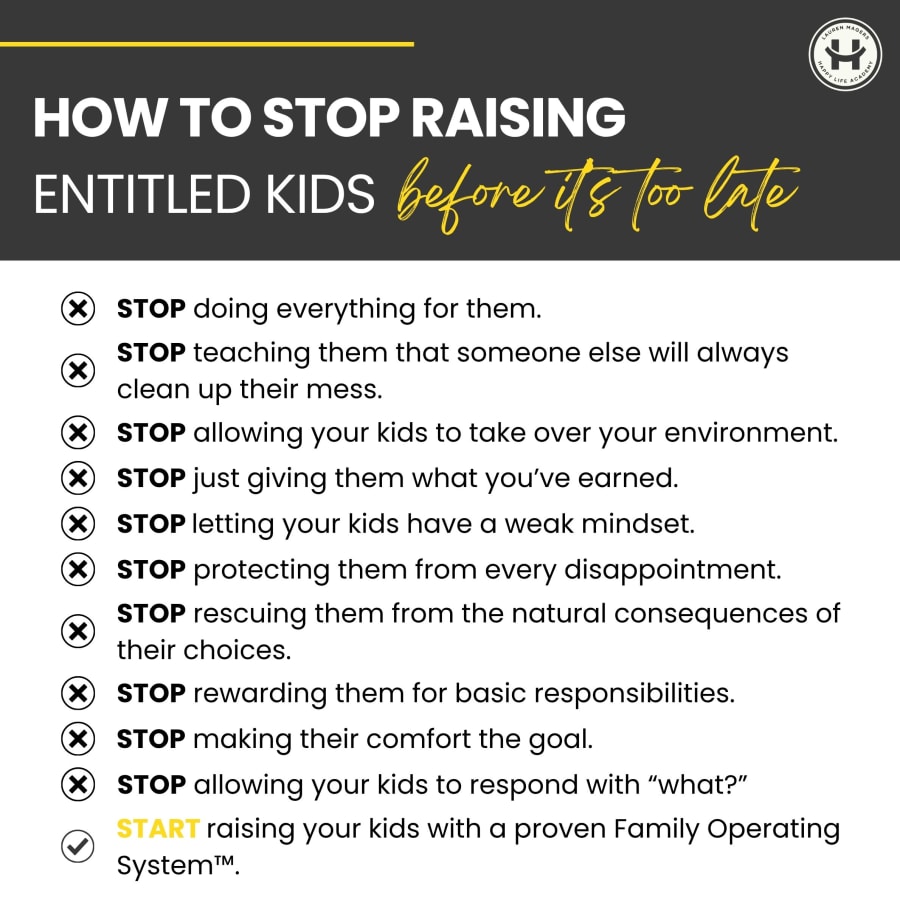
Stop doing everything for them.
Before automatically stepping in, ask yourself, Is my child capable of doing this themselves?
Let them carry their things, make their bed, pour their water, pack what they need, solve age-appropriate problems, and increasingly take care of themselves. It may take longer, and they probably won’t do everything exactly like you would. Let them learn anyway.
Research backs this up, too. In one longitudinal study, mothers who expected their young children to handle age-appropriate responsibilities (like chores and treating others well) had kids who later showed greater compliance and fewer behavior problems.
Guys, I’m telling you, your kids are capable of SO much more than you think. Give them the chance to prove it!
Stop teaching them that someone else will always clean up their mess.
If your child makes the mess, involve them in fixing it. Even when they’re young!
When your kids spill something, they shouldn’t just stand there and look at you. Teach them to grab a towel and clean it up. If they break something, don’t let them say, “It fell off.” Teach them to say, “I was too rough and broke this.” Then work with them on how to make it right. Are we repairing it together, or are you using your own money to replace what you broke?
Accountability teaches children that their actions affect their environment and that they’re capable of making things right.
Stop allowing your kids to take over your environment.
Your child does not get to set the tone for the entire house.
If they’re bored, the whole family doesn’t need to scramble to entertain them. If they’re in a bad mood, everyone else doesn’t have to tiptoe around it. And if they’re upset about a boundary you set, their reaction doesn’t mean the boundary needs to change.
Parents, step into your power here. You set the tone of your home. Your child is allowed to be bored, frustrated, disappointed, or upset without those feelings taking over the entire family environment.
Give them space to work through those emotions instead of making everyone else responsible for fixing them. That’s how kids learn that their feelings matter, but they aren’t in charge.
Want to know more about this? Here’s how to raise your vibration with your child.
Stop just giving them what you’ve earned.
You worked hard for the life you’re able to give your kids. That doesn’t automatically mean everything you've earned belongs to them. In fact, I’d argue the opposite!
Let kids want things, save up, and wait. Give them opportunities to earn special privileges or purchases when appropriate, but just because you can afford to give them the luxuries you enjoy doesn’t mean you should.
They don’t need a Louis Vuitton purse. They don’t need a brand-new car. And, they don’t need first-class plane tickets. There is value in letting your kids experience the gap between what they want and what they’ve earned. Give them an incredible life, absolutely. But don’t rob them of the hunger, drive, and work ethic that helped you build that life in the first place.
Watch: My Instagram reel on letting kids earn what they want
Stop letting your kids have a weak mindset.
Your child is going to say, “I can’t.”
Don’t immediately agree with them by jumping in and doing it yourself.
Remind them what they're capable of. Encourage another attempt. Ask what they could try differently. Help when they actually need support, but don't confuse helping your child with removing every difficult thing from their path.
Resilience develops by experiencing challenges and discovering, I can handle this. When kids realize they’re stronger than they believed, they step into a whole other level of living.
Stop protecting them from every disappointment.
Your child won't get invited to everything. They won't always make the team. Someone else will get the part. Their siblings will occasionally get something they don't. And, truthfully, sometimes the answer to something they deeply want will just be no.
You can empathize with disappointment without making it disappear.
Your job isn't to create a life where your child never feels disappointed. It's to teach them how to experience disappointment without allowing it to define their attitude or behavior.
Stop rescuing them from the natural consequences of their choices.
Forgot something they were responsible for? Don’t automatically rush it to school. Spent all their money? They may have to wait before buying something else.
When it’s safe and appropriate, natural consequences are probably some of the best teachers out there.
If you constantly rescue your child from the results of their decisions, they can learn that someone else will always be there to fix things. Instead, give them opportunities to experience consequences, problem-solve, and make a different choice next time.
Yes, sometimes that means they’ll get a late grade, they’ll be hungry for a little while because they forgot their lunch, or they’ll miss out on something because they didn’t plan ahead. That’s okay. A little discomfort today can teach a lesson that prevents a much bigger problem tomorrow.
Stop rewarding them for basic responsibilities.
Your child shouldn’t need a prize every time they do something expected of them.
There are responsibilities we handle because we’re part of a family and because taking care of ourselves and our environment is part of life.
You can absolutely create separate opportunities for kids to earn money or special privileges. But be careful about attaching a reward to every basic contribution, or you may accidentally teach your child to ask, What do I get out of it? before they're willing to help.
Stop making their comfort the goal.
We love our kids, so of course we want them to be happy. But happiness and constant comfort are not the same thing.
Growth is uncomfortable sometimes. Learning is uncomfortable. Losing is uncomfortable. Waiting is uncomfortable. Working hard is uncomfortable.
Don't remove every difficult feeling from your child's life. Give them the tools and confidence to move through discomfort instead.
Stop allowing your kids to respond with “what?”
How your children communicate with you matters.
If you call your child and their standard response is an irritated “WHAT?” from across the house, you cannot accept that. You are their parent. You raised them. Even though this seems small, it’s huge. They can’t talk to you this way.
Teach respectful communication early and expect everyone in the home, adults included, to speak to one another with basic respect. Next time you call, you better hear, “Yes, Mom?”
The little patterns become the culture of your home.
Start raising your kids with a proven Family Operating System™.
You were never meant to spend your entire life correcting one behavior after another. The backtalk, the messes, the constant asking, the lack of gratitude, the refusal to help . . . the meltdowns when they don’t get what they want. When you deal with every problem separately, parenting becomes an exhausting game of whack-a-mole. You fix one thing, and another pops up.
This is why your family needs a system.
Clear family values, strong boundaries, repeatable routines, and intentional communication create a home where your kids know what’s expected of them, what they’re responsible for, and what it means to be a contributing member of the family.
When that structure becomes part of everyday family life, your kids get hundreds of opportunities to practice responsibility. They learn to take ownership, solve problems, follow through, handle disappointment, and recognize that the world doesn’t revolve around them.
And guys, this changes your life, too.
Imagine not repeating yourself all day. Not carrying the entire mental load. Imagine your kids seeing what needs to be done and actually stepping up. Imagine fewer power struggles, effortless routines, and less pressure on you to keep everything running.
That’s the foundation of Lauren Magers’ Happy Life System™. Instead of waiting for bad behavior to show up and scrambling for another parenting hack, my complete Family Operating System™ gives you the structure to proactively shape the behaviors, habits, and values you want to see in your kids.
This is how you architect a family life filled with more peace, connection, ownership, and joy while raising genuinely grateful, resilient kids. If you’re ready to join the global parenting movement and step into life 2.0, start with my free Family Operating System™ quiz. In just a few minutes, you’ll see where your family is getting stuck and how the Happy Life System™ can bring more structure, shared responsibility, and gratitude into your home. Then you can book a call to map out your next step.
Take the quiz. Build the system. Change everything.
What Causes a Child to Become Entitled?
Entitlement usually isn’t caused by one big parenting mistake. It develops little by little, through the patterns, expectations, and experiences that repeatedly teach a child what they should expect from the people and world around them.
A lack of boundaries can teach kids that “no” is negotiable. Inconsistent expectations can teach them that rules only matter sometimes. Doing everything for them can create dependence. Constant rewards can make contributions feel transactional. Rescuing them from consequences can prevent accountability. And giving them everything immediately can make waiting feel unbearable.
Family structure matters here too. I'm not talking about what your family looks like. I'm talking about whether your home has clear leadership, expectations, responsibilities, routines, and standards everyone understands.
Kids need to know what’s expected of them and where they fit within the family. They also need opportunities to contribute something meaningful to it.
Entitlement grows when children begin believing the family exists to serve them. Contribution teaches them something totally different: I’m an important part of this family, and what I bring to it matters.
Watch: See this on my Instagram
What Are the Signs of an Entitled Child?
Entitled child behavior can look different depending on your child’s age and personality, and seeing a few of these behaviors occasionally doesn’t automatically mean you have an entitled child. Kids are still learning!
What you're looking for are repeated cycles or issues. Some common signs include:
- Expecting to get what they want immediately
- Difficulty accepting “no”
- Little gratitude for what they already have
- Constantly asking for more
- Resistance to helping around the house
- Showing a poor work ethic or avoiding effort
- Complaining about basic school and household responsibilities
- Expecting rewards for things they should already be doing
- Blaming other people when something goes wrong
- Avoiding responsibility for their choices
- Anger or disrespect when they don’t get their way
- Believing rules shouldn’t apply to them
- Low tolerance for disappointment or discomfort
- Taking privileges, belongings, or experiences for granted
- Little consideration for how their actions affect others
- Expecting parents to solve problems for them
- Giving up when something requires effort
- Comparing what they have to what other kids have
- Acting as though their wants should come before everyone else’s needs
Again, don't panic because your ten-year-old complained about unloading the dishwasher yesterday. Look at the larger pattern and, more importantly, what you're reinforcing through your response to it.

Can you reverse entitlement in kids?
Yes! But it’s up to YOU. Reversing entitlement requires more than correcting your child every time they complain, demand something, or refuse to help.
You have to step into your power and permanently raise the standard inside your home.
Never forget: You are the leader of your home.
So, LEAD.
You’re raising our future. Your kids need to know how to work hard, take accountability, respect others, handle disappointment, solve problems, contribute, and keep going when life doesn’t give them exactly what they want.
And guys, that doesn’t happen through one conversation, one chore chart, or one consequence. It takes a system.
When you have a Family Operating System™ guiding how your family lives, leads, communicates, and contributes, these lessons become part of everyday life. Your kids get constant opportunities to practice becoming the humans you know they’re capable of being.
This is so much bigger than stopping entitlement. You’re breaking generational cycles, raising the standard for your family, and changing the trajectory of who your children become.
That’s how we raise grateful, responsible, resilient, world-ready humans.

Written by
Lauren Magers
Lauren Magers is a parenting coach, author, entrepreneur, and mom of four. For 15+ years she has applied business and leadership systems to family life, and she created the Happy Life System™ and its Family Operating System™, which have reached 200,000+ lives in 35+ countries.
More about Lauren